Logical Replication, Decoding, CDC in protobuf/JSON/Mongo format, Copy & Load & Compare Postgres Databases
Repository
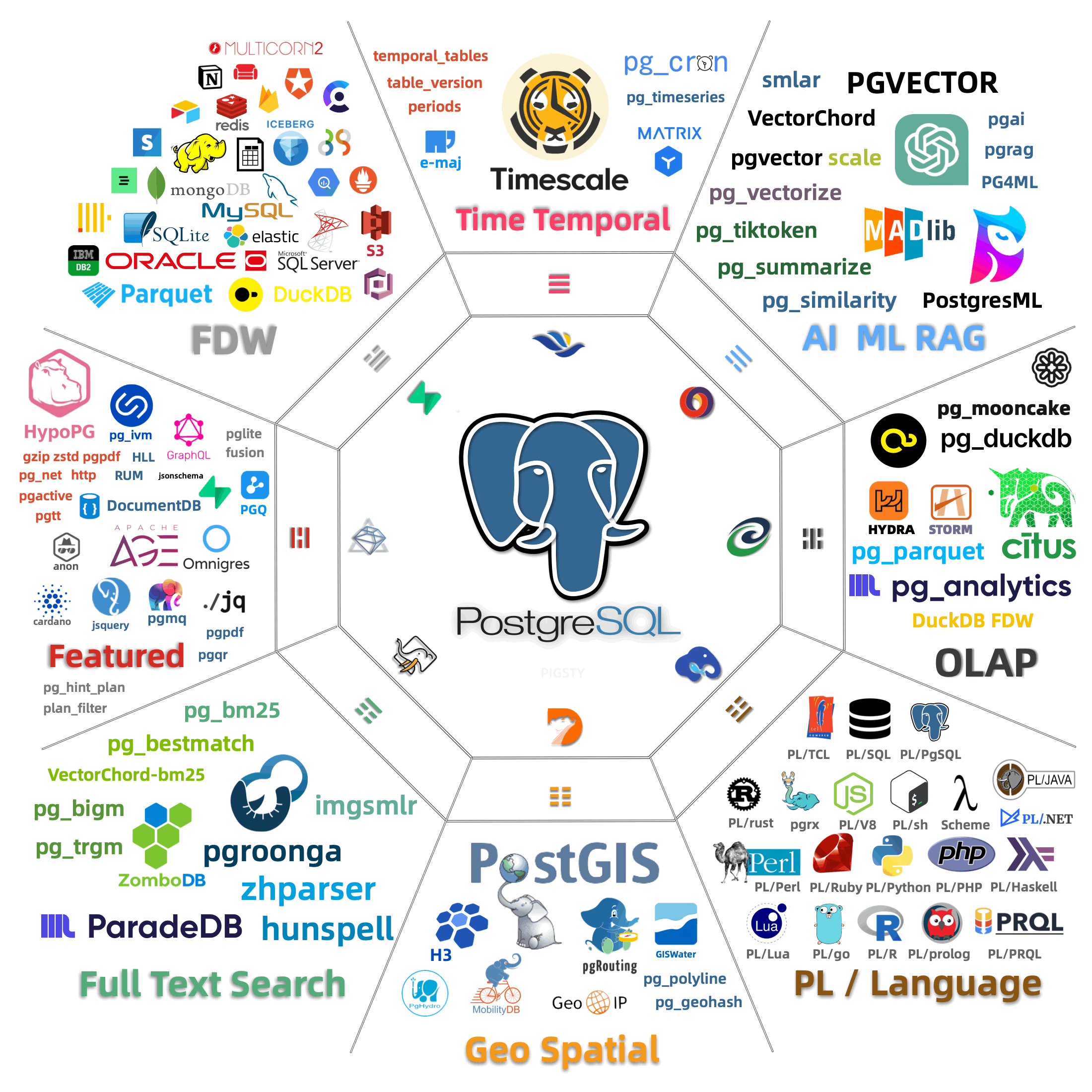
Pigsty has a repository that provides 200+ extra PostgreSQL extensions on 10 mainstream Linux Distros.
It is designed to work together with the official PostgreSQL Global Development Group (PGDG) repo.
You can enable the pigsty infra & pgsql repo with the pig CLI tool, or add them manually to your system:
curl https://repo.pigsty.io/pig | bash # download and install the pig CLI toolpig repo add all -u # add linux, pgdg, pigsty repo and update cache
# Add Pigsty's GPG public key to your system keychain to verify package signaturescurl -fsSL https://repo.pigsty.io/key | sudo gpg --dearmor -o /etc/apt/keyrings/pigsty.gpg
# Get Debian distribution codename (distro_codename=jammy, focal, bullseye, bookworm), and write the corresponding upstream repository address to the APT List filedistro_codename=$(lsb_release -cs)sudo tee /etc/apt/sources.list.d/pigsty-io.list > /dev/null <<EOF
deb [signed-by=/etc/apt/keyrings/pigsty.gpg] https://repo.pigsty.io/apt/infra generic main
deb [signed-by=/etc/apt/keyrings/pigsty.gpg] https://repo.pigsty.io/apt/pgsql/${distro_codename} ${distro_codename} main
EOF# Refresh APT repository cachesudo apt update
# Add Pigsty's GPG public key to your system keychain to verify package signaturescurl -fsSL https://repo.pigsty.io/key | sudo tee /etc/pki/rpm-gpg/RPM-GPG-KEY-pigsty >/dev/null
# Add Pigsty Repo definition files to /etc/yum.repos.d/ directory, including two repositoriessudo tee /etc/yum.repos.d/pigsty-io.repo > /dev/null <<-'EOF'
[pigsty-infra]
name=Pigsty Infra for $basearch
baseurl=https://repo.pigsty.io/yum/infra/$basearch
skip_if_unavailable = 1
enabled = 1
priority = 1
gpgcheck = 1
gpgkey=file:///etc/pki/rpm-gpg/RPM-GPG-KEY-pigsty
module_hotfixes=1
[pigsty-pgsql]
name=Pigsty PGSQL For el$releasever.$basearch
baseurl=https://repo.pigsty.io/yum/pgsql/el$releasever.$basearch
skip_if_unavailable = 1
enabled = 1
priority = 1
gpgcheck = 1
gpgkey=file:///etc/pki/rpm-gpg/RPM-GPG-KEY-pigsty
module_hotfixes=1
EOF# Refresh YUM/DNF repository cachesudo yum makecache;
All the RPM / DEB packages are signed with GPG Key fingerprint (B9BD8B20) in Pigsty repository.
Package Manager
“Postgres Install Genius, the missing extension package manager for PostgreSQL ecosystem”
Simulate other DBMS, and replace vanilla PostgreSQL with exotic forks
Pigsty supports various PostgreSQL kernels and compatible forks,
enabling you to simulate different database systems while leveraging PostgreSQL’s ecosystem.
Each kernel provides unique capabilities and compatibility layers.
Database Kernels
PostgreSQL
Vanilla Postgres with 437 Extensions
Citus
Native Distributive Extension
Babelfish
SQL Server wire-compatible
IvorySQL
Oracle grammar & PL/SQL compatible
OpenHalo
MySQL wire-compatibility
Percona
Transparent Data Encryption
OrioleDB
OLTP-optimized cloud-native storage engine
PolarDB PG
Aurora-like RAC with china domestic compliance
Supabase
Backend as a Service, self-hosting Firebase
FerretDB
Mongo Wire-Compatibility over PostgreSQL
Choose the Right Kernel
Note
Flexible Kernel: Choose the right kernel for your specific use case - whether you need MSSQL compatibility, Oracle features, or horizontal scaling capabilities.
Citus transforms PostgreSQL into a distributed database system, enabling horizontal scaling across multiple nodes.
Deploy native HA Citus clusters with Pigsty for better throughput and performance.
Key Features
Distributed Tables: Automatically shard tables across worker nodes
Distributed Queries: Execute queries across the entire cluster
High Availability: Built-in replication and failover capabilities
Real-time Analytics: Handle both transactional and analytical workloads
Postgres Compatibility: Maintain full PostgreSQL feature compatibility
Self-host Supabase with existing managed HA PostgreSQL clusters, launching the stateless components with docker-compose for a complete Firebase alternative.
Key Features
Real-time APIs: Auto-generated REST and GraphQL APIs
Real-time Subscriptions: WebSocket-based real-time data sync
Authentication: Built-in user authentication and authorization
Storage: File storage with CDN capabilities
Edge Functions: Serverless functions for custom logic
Use Cases
Rapid application development with backend-as-a-service
Real-time applications requiring instant data sync
JAMstack applications needing serverless backend
Mobile and web apps require authentication and storage
Note
Full Stack: Provides a complete backend solution with PostgreSQL as the foundation.
Install and monitor Greenplum / Cloudberry / YMatrix MPP clusters with Pigsty for large-scale analytical processing and data warehousing.
Key Features
Massively Parallel Processing: Distribute queries across multiple nodes
Columnar Storage: Optimized storage for analytical workloads
Advanced Analytics: Built-in machine learning and statistical functions
Petabyte Scale: Handle massive datasets with linear scalability
Standard SQL: Full SQL compliance with PostgreSQL compatibility
Use Cases
Data warehousing and business intelligence
Large-scale analytics and reporting
Machine learning on big datasets
ETL processing for enterprise data platforms
Note
Enterprise Analytics: Designed for enterprise-scale analytical workloads requiring massive parallel processing capabilities.
3 - Observability Infra
Modern observability stack with 3000+ metrics, 30+ dashboards, and enterprise-grade monitoring
Pigsty delivers unparalleled observability with a modern monitoring stack built on industry best practices.
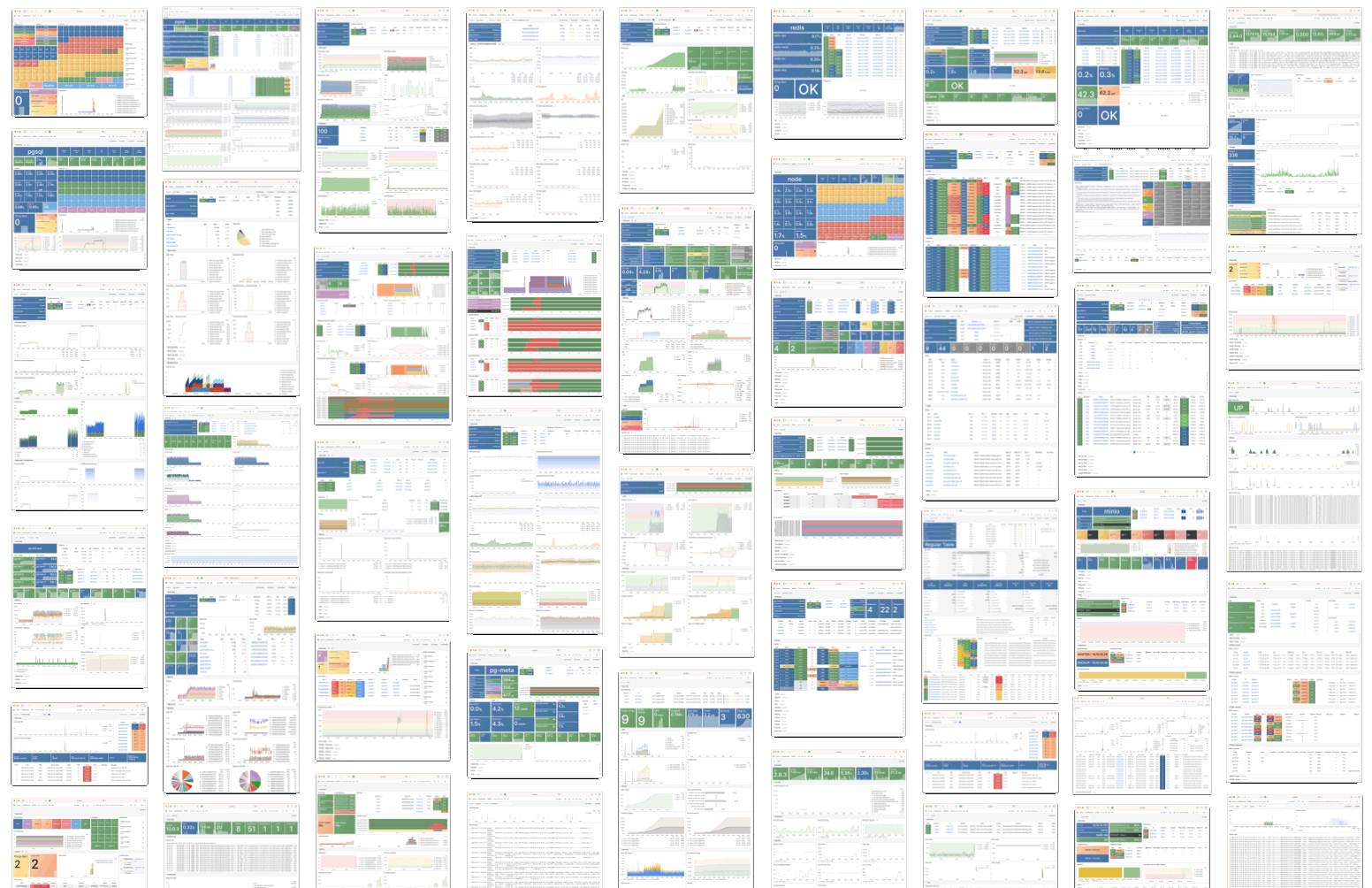
Automatically monitor every component with 3000+ metrics, 30+ dashboards.
Note
Complete Insight: Monitor everything from high-level cluster health to individual table statistics. Get complete insight into the past, present, and future of your infrastructure.
Architecture Overview
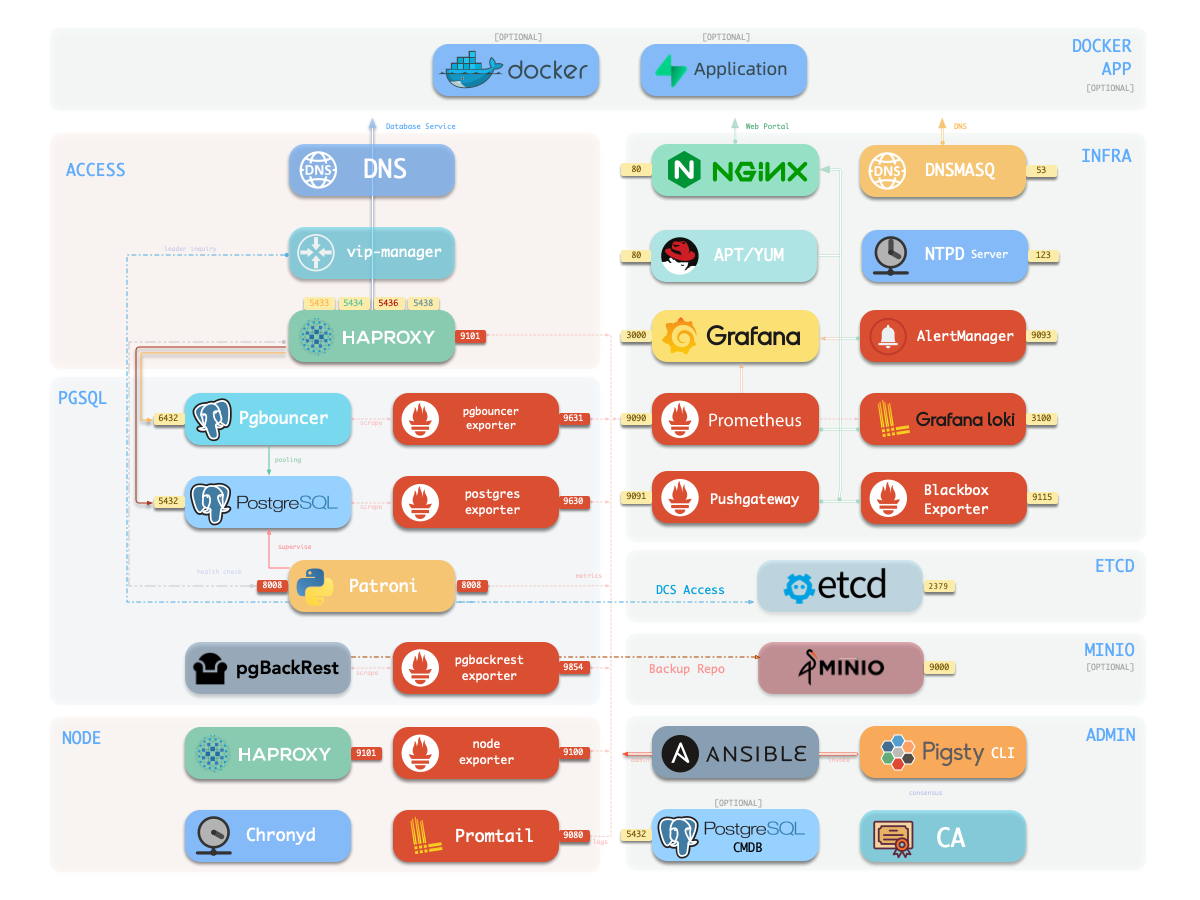
Pigsty’s observability infrastructure leverages battle-tested open-source components in a cohesive, production-ready stack:
Grafana Visualization Engine
Dashboards with advanced interactive visualizations
Purpose: Rich, interactive visualizations for complex data analysis
Data Sources
# Extended data source supportgrafana_datasources:- infinity-datasource # REST API and file data sources- redis-datasource # Redis data source- clickhouse-datasource # ClickHouse integration- postgres-datasource # Enhanced PostgreSQL support
Purpose: Connect to diverse data sources beyond traditional metrics
Advantages: Flexible, lightweight, and highly configurable
Version Compatibility
# PostgreSQL version support matrixsupported_versions:- postgresql_9_6:legacy_metrics_set- postgresql_10:enhanced_metrics_set- postgresql_11:advanced_metrics_set- postgresql_12:modern_metrics_set- postgresql_13:extended_metrics_set- postgresql_14:latest_metrics_set- postgresql_15:cutting_edge_metrics_set- postgresql_16:next_gen_metrics_set
Benefit: Single exporter for heterogeneous PostgreSQL environments
Custom Queries
# Custom metric definition examplecustom_queries:pg_custom_business_metrics:query:| SELECT
schemaname,
tablename,
n_tup_ins as inserts_total,
n_tup_upd as updates_total,
n_tup_del as deletes_total
FROM pg_stat_user_tablesmetrics:- inserts_total:usage:COUNTERdescription:"Total number of inserts"- updates_total:usage:COUNTERdescription:"Total number of updates"
Pigsty v3.7 installs node_exporter on managed nodes and registers Node,
HAProxy, Keepalived, Nginx, Etcd, MinIO, Redis, PostgreSQL, PgBouncer, and
pgBackRest targets with Prometheus when the corresponding modules are
enabled. Component ports and switches are defined by the tagged role
defaults and documented on each module’s parameter page.
External Database Monitoring
Existing PostgreSQL instances and cloud RDS can be registered with
pgsql-monitor.yml. Supply a monitor connection URL with only the required
pg_monitor privileges; Pigsty registers pg_exporter and the Grafana
datasource without provisioning or changing that database.
Grafana can query both Prometheus metrics and PostgreSQL data. The bundled
dashboards use variables and URL links for drill-down navigation; ECharts
and other packaged plugins can visualize application or business data.
Low-Code Application Development
Grafana panels may be combined with PostgreSQL queries to build internal
operational views. This is a visualization capability, not a separate
Pigsty deployment module or application API.
Reusable Infrastructure
infra.yml can deploy INFRA independently from PGSQL. Nginx, DNSMasq,
Prometheus, AlertManager, Grafana, and Loki are controlled by their
documented *_enabled parameters, allowing Pigsty to reuse or coexist with
existing infrastructure.
Best Practices
Control metric cardinality and set retention according to available disk.
Back up Grafana configuration and keep alert notification channels tested.
Protect monitoring endpoints with access controls and HTTPS when exposed
outside the trusted network.
Monitor the monitoring stack itself and review storage growth regularly.
Limitations & Considerations
Prometheus and Loki in v3.7 are single-node services by default. Very large
metric cardinality, long retention, or complex dashboards require capacity
planning. External long-term storage and HA monitoring architectures are
manual integrations rather than built-in v3.7 modules.
4 - High Availability
Enterprise-grade high availability with automatic failover and self-healing capabilities
Pigsty uses Patroni to achieve high availability for PostgreSQL, ensuring automatic failover.
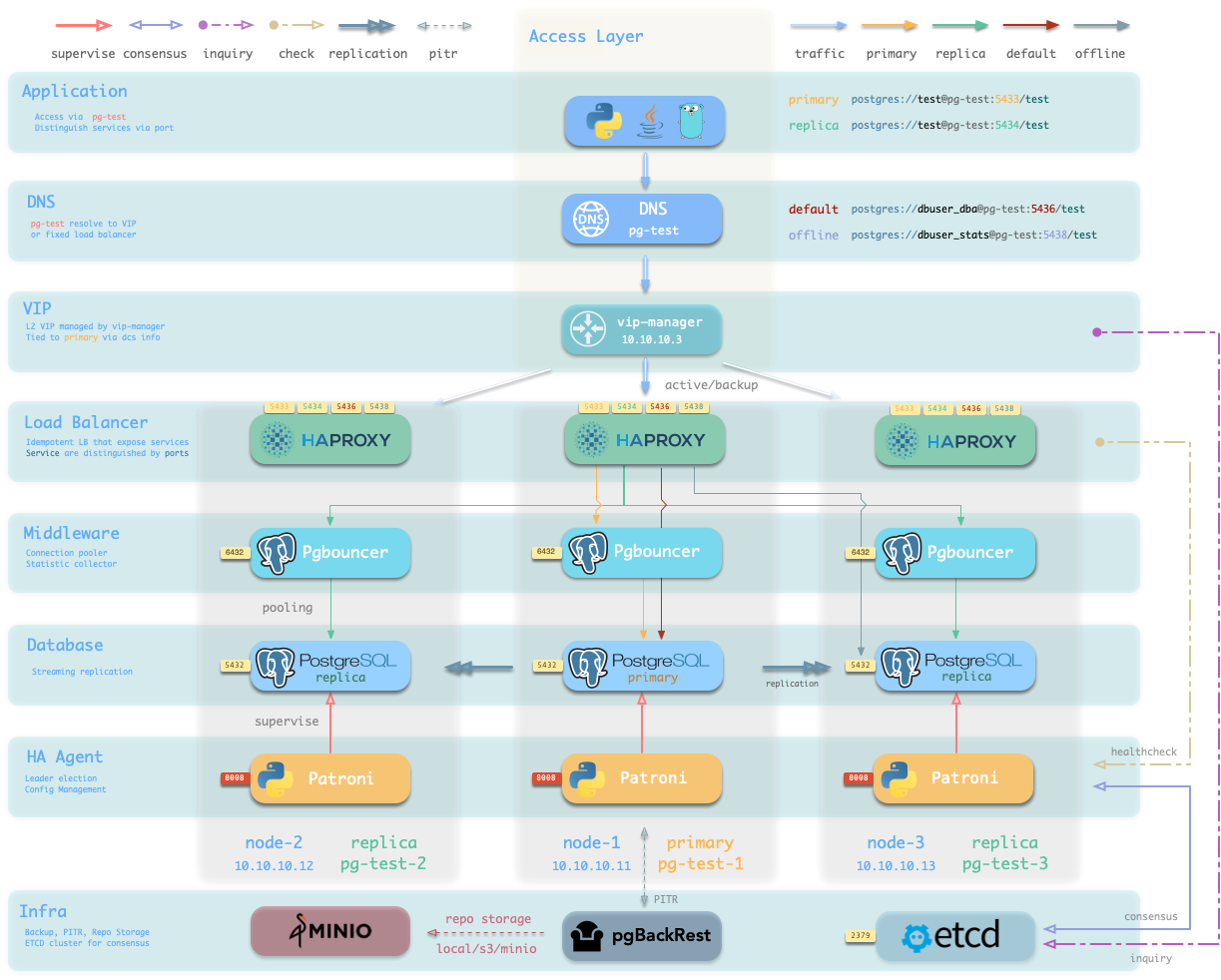
Pigsty’s PostgreSQL cluster has battery-included high-availability powered by Patroni, Etcd, and HAProxy.
When you have two or more instances in the PostgreSQL cluster, you have the ability to self-heal from hardware failures without any further configuration — as long as any instance within the cluster survives, the cluster can serve its services. Clients simply need to connect to any node in the cluster to obtain full services without worrying about replication topology changes.
By default, the recovery time objective (RTO) for primary failure is approximately 30s ~ 60s, and the data recovery point objective (RPO) is < 1MB; for standby failure, RPO = 0, RTO ≈ 0 (instantaneous). In consistency-first mode, zero data loss during failover is guaranteed: RPO = 0. These metrics can be configured as needed based on your actual hardware conditions and reliability requirements.
Pigsty incorporates an HAProxy load balancer for automatic traffic switching, offering multiple access methods for clients such as DNS/VIP/LVS. Failovers and switchover are almost imperceptible to the business side except for sporadic interruptions, meaning applications do not need connection string modifications or restarts.
Key Metrics
RTO ~ 30s
Primary Failure
RPO < 1MB
Async Mode RPO
RTO ~ 0s
Replica Failure
RPO = 0
Sync Mode
What High Availability Solves
High availability addresses critical operational challenges:
Data Safety
Elevates availability: RPO ≈ 0, RTO < 30s for enhanced data protection
Rolling Maintenance
Seamless maintenance: Minimize maintenance windows for operational convenience
Hardware Failures
Self-healing: Automatic recovery from hardware failures without human intervention
Load Distribution
Read scaling: Distribute read-only queries across standby instances
Specific Benefits
Enhanced data safety: Improves the availability aspect of data safety CIA to a new height
Rolling maintenance capabilities: Enables seamless maintenance with minimal downtime
Hardware failure recovery: Self-healing from hardware failures without human intervention
Load sharing: Read-only requests can be distributed across standby instances
Costs of High Availability
Implementing HA introduces certain trade-offs and requirements:
Note
Infrastructure Requirements: HA requires at least 3 nodes and additional infrastructure dependencies.
Resource Requirements
Minimum cluster size: At least 3 nodes for proper consensus
Additional infrastructure: Requires consensus store (Etcd) and load balancer
Resource overhead: Additional CPU, memory, and network resources
Operational complexity: Increased monitoring and management requirements
Limitations
Note
High availability cannot prevent:
Human errors and operational mistakes
Software defects causing data corruption
Logical data deletion or corruption
For these scenarios, additional recovery strategies are needed:
Network conditions significantly affect HA behavior:
High-quality networks: Can use lower RTO values safely
Unstable networks: Require higher RTO to prevent false positives
WAN deployments: Need careful tuning of timeout parameters
Local networks: Can optimize for faster failover
Monitoring and Observability
Pigsty provides comprehensive monitoring for HA cluster health:
Key Metrics
Cluster State
Monitor cluster topology, leader status, and member health
Replication Lag
Track replication lag and sync status across all replicas
Failover Events
Log and analyze failover events and their impact
Performance
Monitor query performance and connection health
Dashboard Integration
Pigsty includes pre-built Grafana dashboards for HA monitoring:
Cluster Overview: Real-time cluster topology and health
Replication Monitoring: Lag metrics and sync status
Failover Analysis: Historical failover events and timing
Performance Metrics: Query performance during normal and failover scenarios
Best Practices
Deployment Recommendations
Note
Anti-Affinity: Deploy cluster nodes across different physical hosts, racks, or availability zones.
Hardware diversity: Use different hardware configurations to avoid common failure modes
Network redundancy: Ensure multiple network paths between cluster nodes
Storage considerations: Use local storage for best performance, shared storage for specific use cases
Monitoring setup: Implement comprehensive monitoring before going to production
Operational Guidelines
Regular testing: Perform controlled failover tests in non-production environments
Capacity planning: Size cluster nodes appropriately for failover scenarios
Backup strategy: Maintain regular backups independent of HA setup
Documentation: Keep runbooks updated for emergency procedures
Common Pitfalls
Note
Avoid These Common Mistakes:
Insufficient network bandwidth between nodes
Inadequate monitoring of replication lag
Not testing failover procedures regularly
Incorrect firewall configurations
Summary
Pigsty’s high availability solution provides:
Automatic failover with sub-minute RTO
Configurable consistency with RPO control
Self-healing capabilities for hardware failures
Load balancing for read scaling
Minimal operational overhead with automated management
The combination of Patroni, Etcd, and HAProxy creates a robust, production-ready HA solution that handles the majority of failure scenarios automatically while providing the flexibility to tune behavior based on specific requirements.
High availability is not just about technology—it’s about building resilient systems that your business can depend on.
5 - Disaster Recovery
Battle-tested backup strategies and auto-configured Point-in-Time Recovery
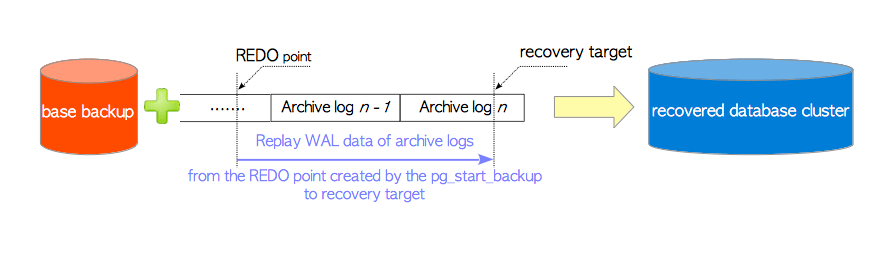
Point-in-Time Recovery (PITR) allows rolling back a PostgreSQL cluster to any specific moment in the past, preventing data loss from software defects or human errors. Pigsty uses pgBackRest for PITR, with configurable backup strategies using local filesystems or object storage like MinIO.
Note
Time Travel for Databases: Roll back your cluster to any point in time, protecting against software defects, human errors, and data corruption scenarios that high availability cannot address.
Overview
Pigsty provides enterprise-grade Point-in-Time Recovery with zero-configuration setup, automated backups, and flexible restore options. Built on pgBackRest with MinIO/S3 support, it protects against data corruption, human errors, and logical disasters.
Reduced RPO
Minimize Recovery Point Objective with continuous WAL archiving
Data Integrity
Enhanced data integrity protection against corruption
Disaster Recovery
Improved disaster recovery capabilities with flexible restore options
How PITR Works
PITR requires two key components working together to enable point-in-time recovery:
Base Backups
Base Backups
Uses pgBackRest to create database cluster snapshots with multiple backup types:

- **Full backups**: Complete database cluster snapshots
- **Incremental backups**: Only changes since the last backup
- **Differential backups**: Changes since the last full backup
- **Scheduled backups**: Periodic backups configured via Crontab
WAL Archiving
WAL Archiving
Continuously archives Write-Ahead Log (WAL) segment files:

- **Continuous archiving**: Real-time WAL file preservation
- **Automatic management**: WAL files and cleanup handled automatically
- **Optional feature**: Can be disabled if PITR is not needed
Implementation
Pigsty provides two default backup strategies with flexible configuration options:
Local Filesystem
Local Filesystem Strategy
- **Frequency**: Daily full backups
- **Storage**: Local filesystem storage
- **Use case**: Single-node or local development environments
MinIO/S3
MinIO/S3 Strategy
- **Frequency**: Weekly full backup with daily incremental backups
- **Storage**: Object storage (MinIO, S3)
- **Use case**: Production environments with distributed storage
Configuration Options
Backup configuration is highly flexible with options to specify:
Repository type: Local, S3, or other supported backends
Retention policies: How long to keep backups
Encryption: Secure backup storage
Storage locations: Multiple backup destinations
Recovery Options
Note
Recovery operations should be performed carefully as they will replace the current database state.
Recovery commands allow restoring to various points in time:
Step 1
### Latest WAL Archive
Restore to the most recent point available in WAL archives:
```bash
pg-pitr
```
Step 2
### Specific Timestamp
Restore to an exact moment in time:
```bash
pg-pitr --time="2022-12-30 14:44:44+08"
```
Step 3
### Named Restore Point
Restore to a previously created named point:
```bash
pg-pitr --name="my-restore-point"
```
Step 4
### Specific LSN or Transaction ID
Restore to a particular Log Sequence Number or transaction:
```bash
pg-pitr --lsn="0/1234567"
pg-pitr --xid="12345"
```
Note
While PITR is powerful for data recovery, it should ideally be combined with High Availability solutions for comprehensive data protection against both logical and physical failures.
6 - Infra as Code
Declarative infrastructure and database management with YAML-driven configuration
Pigsty provides a declarative interface: Describe everything in a config file, and Pigsty operates it to the desired state with idempotent playbooks. It works like Kubernetes CRDs & Operators but for databases and infrastructures on any nodes: bare metal or virtual machines.
Note
Infra as Code, Database as Code: Declarative API & Idempotent Playbooks, GitOPS works like a charm.
Declare Module
You can declare modules on a single node:
# infra cluster for proxy, monitor, alert, etc...infra:{hosts:{10.10.10.10:{infra_seq:1}}}# minio cluster, s3 compatible object storageminio:{hosts:{10.10.10.10:{minio_seq:1 } }, vars:{minio_cluster:minio } }# etcd cluster for ha postgres DCSetcd:{hosts:{10.10.10.10:{etcd_seq:1 } }, vars:{etcd_cluster:etcd } }# postgres example cluster: pg-metapg-meta:{hosts:{10.10.10.10:{pg_seq:1, pg_role:primary } }, vars:{pg_cluster:pg-meta } }
And apply with playbooks:
./infra.yml -l infra # init infra module on node 10.10.10.10./etcd.yml -l etcd # init etcd module on node 10.10.10.10./minio.yml -l minio # init minio module on node 10.10.10.10./pgsql.yml -l pg-meta # init pgsql module on node 10.10.10.10
Declare Cluster
To create a three-node HA postgres cluster with streaming replication:
pg-meta:hosts:10.10.10.10:{pg_seq:1, pg_role:primary }vars:pg_cluster:pg-metapg_databases:- name:metabaseline:cmdb.sqlcomment:pigsty meta databaseschemas:[pigsty]extensions:- {name:adminpack, schema:pg_catalog }- {name:postgis, schema:public }- {name:timescaledb, schema:public }pg_users:- {name:dbuser_meta, password:DBUser.Meta, pgbouncer:true, roles:[dbrole_admin], comment:pigsty admin user }- {name:dbuser_view, password:DBUser.Viewer, pgbouncer:true, roles:[dbrole_readonly], comment:pigsty read-only user }pg_services:- {name:primary, port:5433, dest:default }- {name:replica, port:5434, dest:default, selector:"[]"}- {name:default, port:5436, dest:postgres }- {name:offline, port:5438, dest:postgres, selector:"[]"}pg_hba_rules:- {user:dbuser_view, db:all, addr:infra, auth:pwd, title:'allow view user from infra nodes'}pgb_hba_rules:- {user:dbuser_view, db:all, addr:infra, auth:pwd, title:'allow view user from infra nodes'}
Declare Access Control
Define advanced access control rules:
pg_hba_rules:- {user:'${dbsu}', db:all, addr:local, auth:ident, title:'dbsu access via local os user ident'}- {user:'${dbsu}', db:replication, addr:local, auth:ident, title:'dbsu replication from local os ident'}- {user:'${repl}', db:replication, addr:'${ip}/32', auth:pwd, title:'replicator replication from ${ip}'}- {user:'${repl}', db:postgres, addr:'${ip}/32', auth:pwd, title:'replicator postgres db from ${ip}'}- {user:'${monitor}', db:all, addr:'${ip}/32', auth:pwd, title:'monitor from ${ip}'}- {user:'${monitor}', db:all, addr:infra, auth:pwd, title:'monitor from infra nodes'}- {user:'${admin}', db:all, addr:infra, auth:ssl, title:'admin @ infra nodes with pwd & ssl'}- {user:'+dbrole_readonly', db:all, addr:'${vip}/32', auth:ssl, title:'allow readonly role from ${vip} with ssl'}- {user:'+dbrole_offline', db:all, addr:'${vip}/32', auth:ssl, title:'allow offline role from ${vip} with ssl'}- {user:dbuser_meta, db:meta, addr:'10.0.0.0/8', auth:ssl, title:'allow meta user from 10.0.0.0/8 with ssl'}
Pigsty enables you to describe your entire infrastructure declaratively and manage it through code, providing consistency, repeatability, and scalability for your database and infrastructure operations.
7 - No Containers
Pigsty runs on raw Linux without containers and kubernetes
Pigsty runs on bare Linux, We support mainstream Linux distributions like EL / Debian / Ubuntu, and compatible Linux distributions like Rocky Linux, AlmaLinux, etc…
We do this on purpose. It is hard to compile and package all the postgres related packages and hundreds of extensions into RPM/DEB for each Major version x PG version x OS Arch…
But I believe this is the right thing to do. So we don’t take shortcuts like Docker, Podman, or Kubernetes.
8 - App Templates
Setup enterprise software with templates, supabase, odoo, dify, gitlab,…
Supabase
Self-Hosting Supabase
Odoo
Run Odoo the OSS ERP
Dify
Run Dify the AI workflow
pgAdmin
Run official Admin GUI Tool
9 - Local First
Install without Internet, All dependencies included
10 - Supabase
Turn Postgres into a full-featured backend as a service