Service
Service Implementation
In Pigsty, services are implemented using haproxy on nodes, differentiated by different ports on the host node.
Every node has Haproxy enabled to expose services. From the database perspective, nodes in the cluster may be primary or replicas, but from the service perspective, all nodes are the same. This means even if you access a replica node, as long as you use the correct service port, you can still use the primary’s read-write service. This design seals the complexity: as long as you can access any instance on the PostgreSQL cluster, you can fully access all services.
This design is akin to the NodePort service in Kubernetes. Similarly, in Pigsty, every service includes these two core elements:
- Access endpoints exposed via NodePort (port number, from where to access?)
- Target instances chosen through Selectors (list of instances, who will handle it?)
The boundary of Pigsty’s service delivery stops at the cluster’s HAProxy. Users can access these load balancers in various ways. Please refer to Access Service.
All services are declared through configuration files. For instance, the default PostgreSQL service is defined by the pg_default_services parameter:
You can also define new service in pg_services. And pg_default_services and pg_services are both arrays of Service Definition.
Define Services
The default services are defined in pg_default_services.
While you can define your extra PostgreSQL services with pg_services @ the global or cluster level.
These two parameters are both arrays of service objects. Each service definition will be rendered as a haproxy config in /etc/haproxy/<svcname>.cfg, check service.cfg for details.
Here is an example of an extra service definition: standby
And it will be translated to a haproxy config file /etc/haproxy/pg-test-standby.conf:
Reload Service
When cluster membership has changed, such as append / remove replicas, switchover/failover, or adjust relative weight, You have to reload service to make the changes take effect.
Override Service
You can override the default service configuration in several ways:
Bypass Pgbouncer
When defining a service, if svc.dest='default', this parameter pg_default_service_dest will be used as the default value. pgbouncer is used by default, you can use postgres instead, so the default primary & replica service will bypass pgbouncer and route traffic to postgres directly
If you don’t need connection pooling at all, you can change pg_default_service_dest to postgres, and remove default and offline services.
If you don’t need read-only replicas for online traffic, you can remove replica from pg_default_services too.
Delegate Service
Pigsty exposes PostgreSQL services with haproxy on node. All haproxy instances among the cluster are configured with the same service definition.
However, you can delegate pg service to a specific node group (e.g., dedicate haproxy lb cluster) rather than cluster members.
To do so, you will have to override the default service definition with pg_default_services and set pg_service_provider to the proxy group name.
For example, this configuration will expose pg cluster primary service on haproxy node group proxy with port 10013.
It’s user’s responsibility to make sure each delegate service port is unique among the proxy cluster.
Split read & write, route traffic to the right place, and achieve stable & reliable access to the PostgreSQL cluster.
Service is an abstraction to seal the details of the underlying cluster, especially during cluster failover/switchover.
Personal User
Service is meaningless to personal users. You can access the database with raw IP address or whatever method you like.
Service Overview
We utilize a PostgreSQL database cluster based on replication in real-world production environments. Within the cluster, only one instance is the leader (primary) that can accept writes. Other instances (replicas) continuously fetch WAL from the leader to stay synchronized. Additionally, replicas can handle read-only queries and offload the primary in read-heavy, write-light scenarios. Thus, distinguishing between write and read-only requests is a common practice.
Moreover, we pool requests through a connection pooling middleware (Pgbouncer) for high-frequency, short-lived connections to reduce the overhead of connection and backend process creation. And, for scenarios like ETL and change execution, we need to bypass the connection pool and directly access the database servers. Furthermore, high-availability clusters may undergo failover during failures, causing a change in the cluster leadership. Therefore, the RW requests should be re-routed automatically to the new leader.
These varied requirements (read-write separation, pooling vs. direct connection, and client request failover) have led to the abstraction of the service concept.
Typically, a database cluster must provide this basic service:
- Read-write service (primary): Can read and write to the database.
For production database clusters, at least these two services should be provided:
- Read-write service (primary): Write data: Only carried by the primary.
- Read-only service (replica): Read data: Can be carried by replicas, but fallback to the primary if no replicas are available.
Additionally, there might be other services, such as:
- Direct access service (default): Allows (admin) users to bypass the connection pool and directly access the database.
- Offline replica service (offline): A dedicated replica that doesn’t handle online read traffic, used for ETL and analytical queries.
- Synchronous replica service (standby): A read-only service with no replication delay, handled by synchronous standby/primary for read queries.
- Delayed replica service (delayed): Accesses older data from the same cluster from a certain time ago, handled by delayed replicas.
Default Service
Pigsty will enable four default services for each PostgreSQL cluster:
| service | port | description |
|---|---|---|
| primary | 5433 | pgbouncer read/write, connect to primary 5432 or 6432 |
| replica | 5434 | pgbouncer read-only, connect to replicas 5432/6432 |
| default | 5436 | admin or direct access to primary |
| offline | 5438 | OLAP, ETL, personal user, interactive queries |
Take the default pg-meta cluster as an example, you can access these services in the following ways:
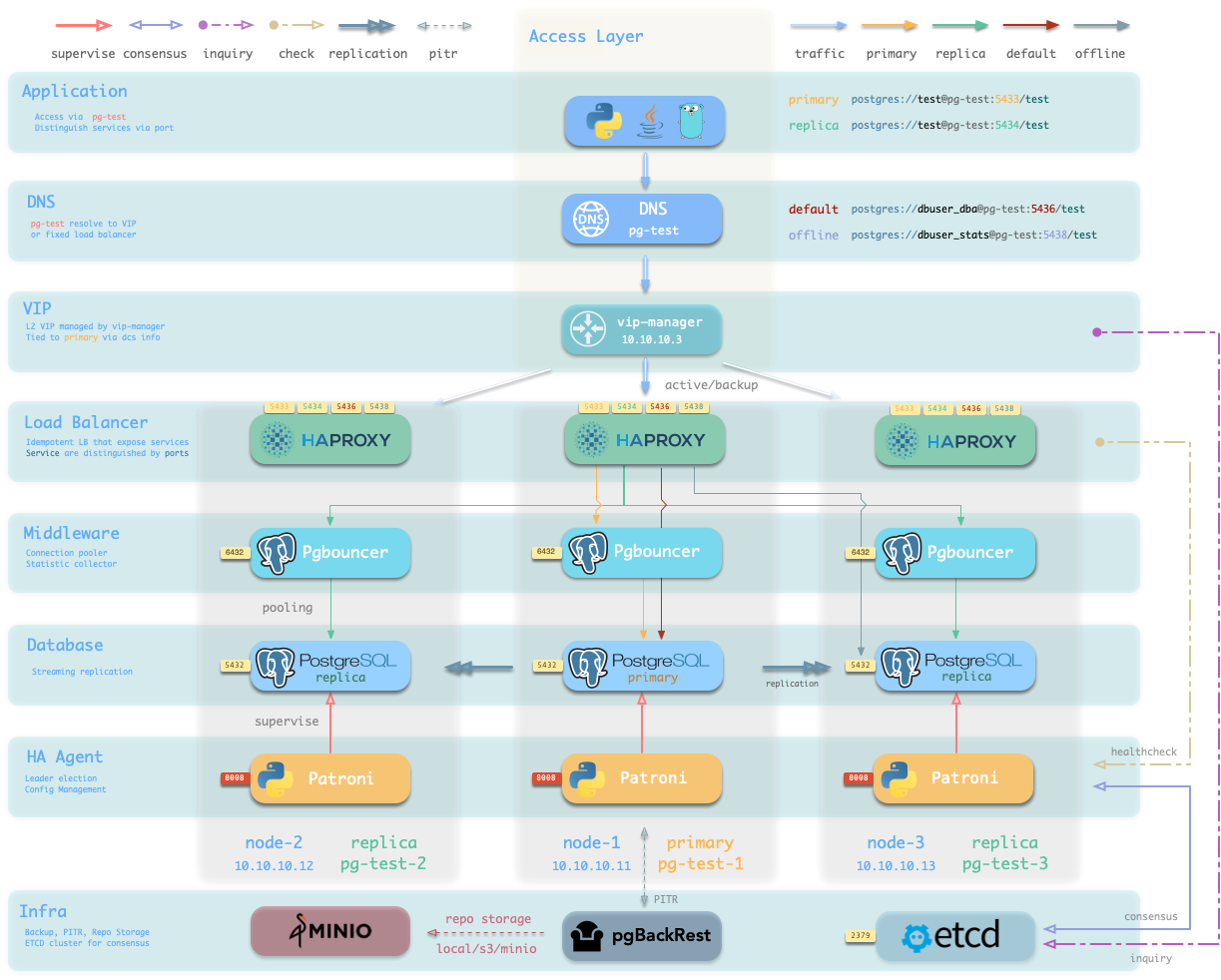
Here the pg-meta domain name is point to the cluster’s L2 VIP, which in turn points to the haproxy load balancer on the primary instance.
It is responsible for routing traffic to different instances, check Access Services for details.
Primary Service
The primary service may be the most critical service for production usage.
It will route traffic to the primary instance, depending on pg_default_service_dest:
pgbouncer: route traffic to primary pgbouncer port (6432), which is the default behaviorpostgres: route traffic to primary postgres port (5432) directly if you don’t want to use pgbouncer
It means all cluster members will be included in the primary service (selector: "[]"), but the one and only one instance that past health check (check: /primary) will be used as the primary instance. Patroni will guarantee that only one instance is primary at any time, so the primary service will always route traffic to THE primary instance.
Replica Service
The replica service is used for production read-only traffic.
There may be many more read-only queries than read-write queries in real-world scenarios. You may have many replicas.
The replica service will route traffic to Pgbouncer or postgres depending on pg_default_service_dest, just like the primary service.
The replica service traffic will try to use common pg instances with pg_role = replica to alleviate the load on the primary instance as much as possible. It will try NOT to use instances with pg_role = offline to avoid mixing OLAP & OLTP queries as much as possible.
All cluster members will be included in the replica service (selector: "[]") when it passes the read-only health check (check: /read-only). primary and offline instances are used as backup servers, which will take over in case of all replica instances are down.
Default Service
The default service will route to primary postgres (5432) by default.
It is quite like the primary service, except it will always bypass pgbouncer, regardless of pg_default_service_dest. Which is useful for administration connection, ETL writes, CDC changing data capture, etc…
Offline Service
The Offline service will route traffic to dedicate postgres instance directly.
Which could be a pg_role = offline instance, or a pg_offline_query flagged instance.
If no such instance is found, it will fall back to any replica instances. the bottom line is: it will never route traffic to the primary instance.
Access Service
Pigsty exposes service with haproxy. Which is enabled on all nodes by default.
haproxy load balancers are idempotent among the same pg cluster by default, you use ANY / ALL of them by all means.
The typical method is access via cluster domain name, which resolves to cluster L2 VIP, or all instances ip address in a round-robin manner.
Service can be implemented in different ways. You can even implement your own access method such as L4 LVS, F5, etc… instead of haproxy.
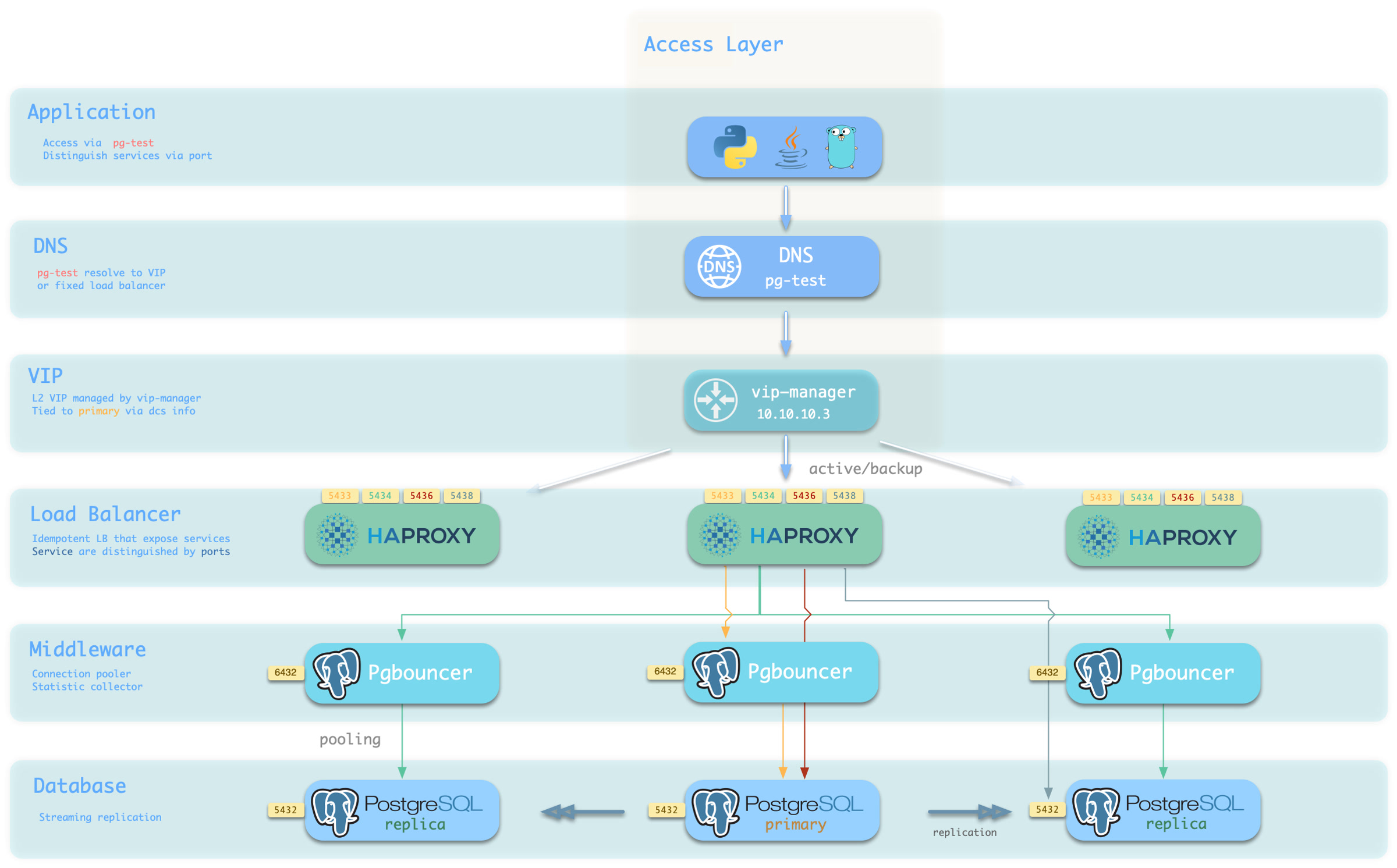
You can use a different combination of host & port, they are providing PostgreSQL service in different ways.
Host
| type | sample | description |
|---|---|---|
| Cluster Domain Name | pg-test |
via cluster domain name (resolved by dnsmasq @ infra nodes) |
| Cluster VIP Address | 10.10.10.3 |
via a L2 VIP address managed by vip-manager, bind to primary |
| Instance Hostname | pg-test-1 |
Access via any instance hostname (resolved by dnsmasq @ infra nodes) |
| Instance IP Address | 10.10.10.11 |
Access any instance ip address |
Port
Pigsty uses different ports to distinguish between pg services:
| port | service | type | description |
|---|---|---|---|
| 5432 | postgres | database | Direct access to postgres server |
| 6432 | pgbouncer | middleware | Go through connection pool middleware before postgres |
| 5433 | primary | service | Access primary pgbouncer (or postgres) |
| 5434 | replica | service | Access replica pgbouncer (or postgres) |
| 5436 | default | service | Access primary postgres |
| 5438 | offline | service | Access offline postgres |
Combinations