Version v3.7.0 of the documentation is no longer actively maintained. The site that you are currently viewing is an archived snapshot. For up-to-date documentation, see the latest version.

Pigsty v1.3: Redis Support, PGCAT Overhaul, PGSQL Enhancements
Originally published on VONNG.

Pigsty v1.3 is officially released, featuring Redis support, a rebuilt PGCAT application, and enhanced PGSQL monitoring.
Redis Support
While PostgreSQL is the world’s most advanced open-source relational database, every hero needs a sidekick. Pigsty v1.3 introduces a powerful caching companion for PostgreSQL: the world’s fastest database — Redis.
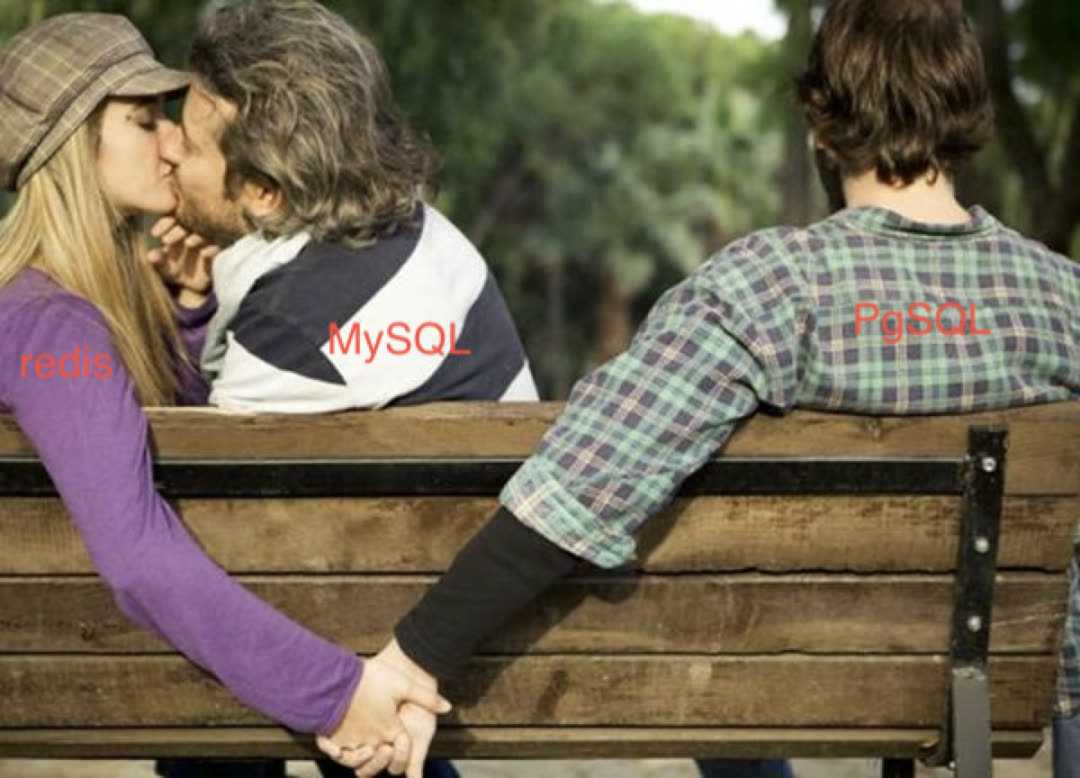
Redis delivers incredible performance, easily hitting 200-300k QPS on a single core.
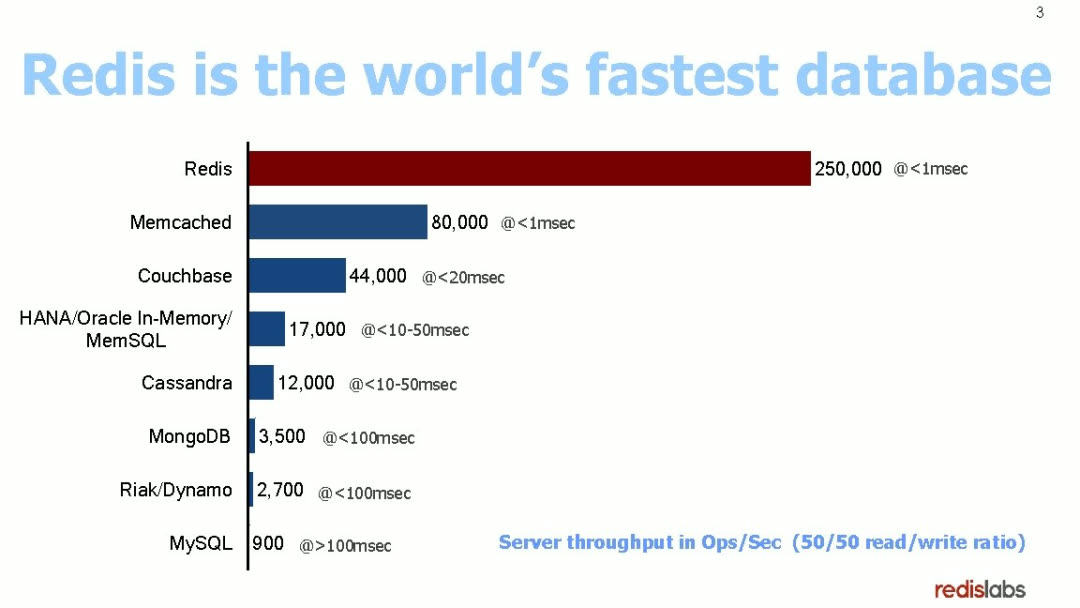
The Pigsty demo now includes Redis cluster examples:
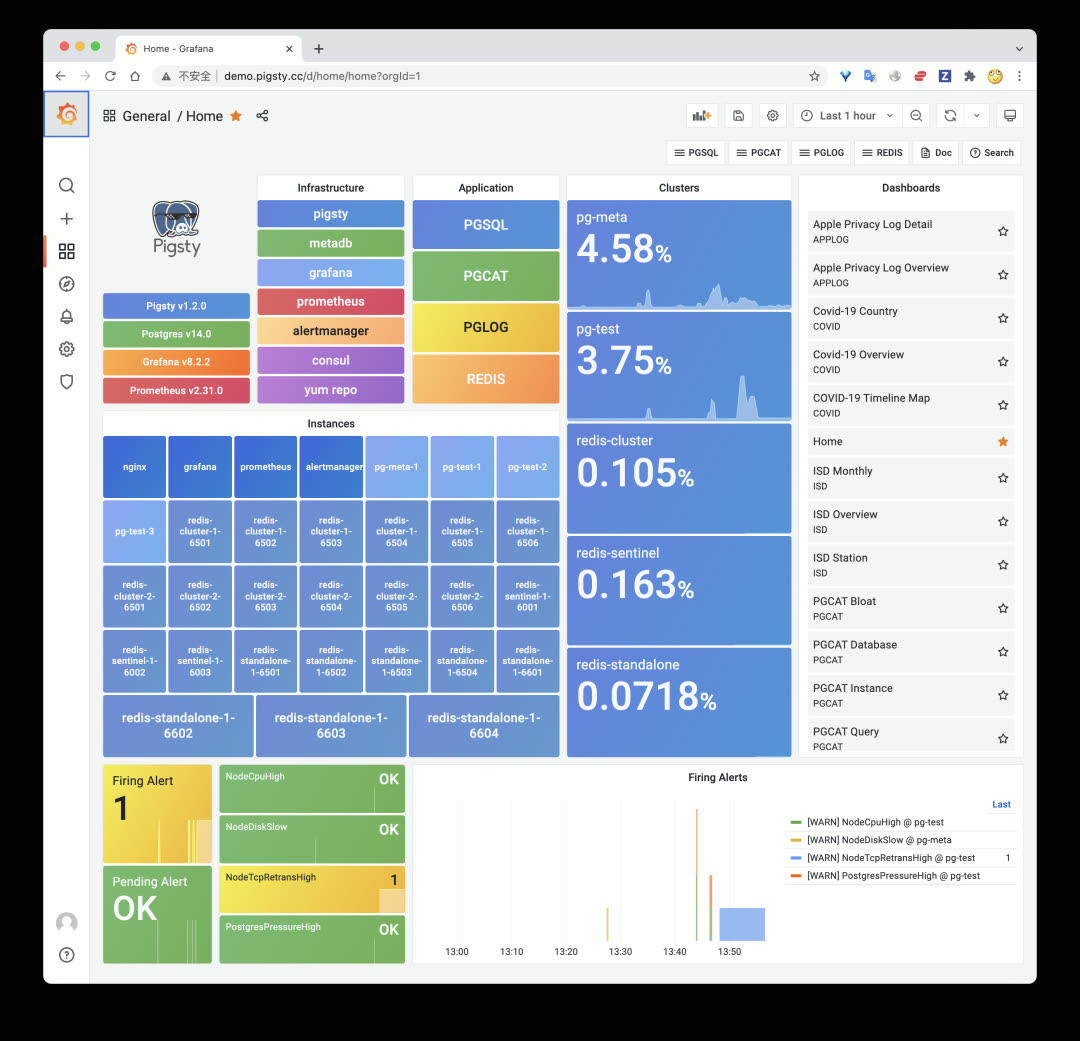
Three Deployment Modes
Redis has three classic deployment patterns: primary-replica (Standalone), native cluster (Cluster), and high-availability sentinel (Sentinel). Pigsty v1.3 supports all three.
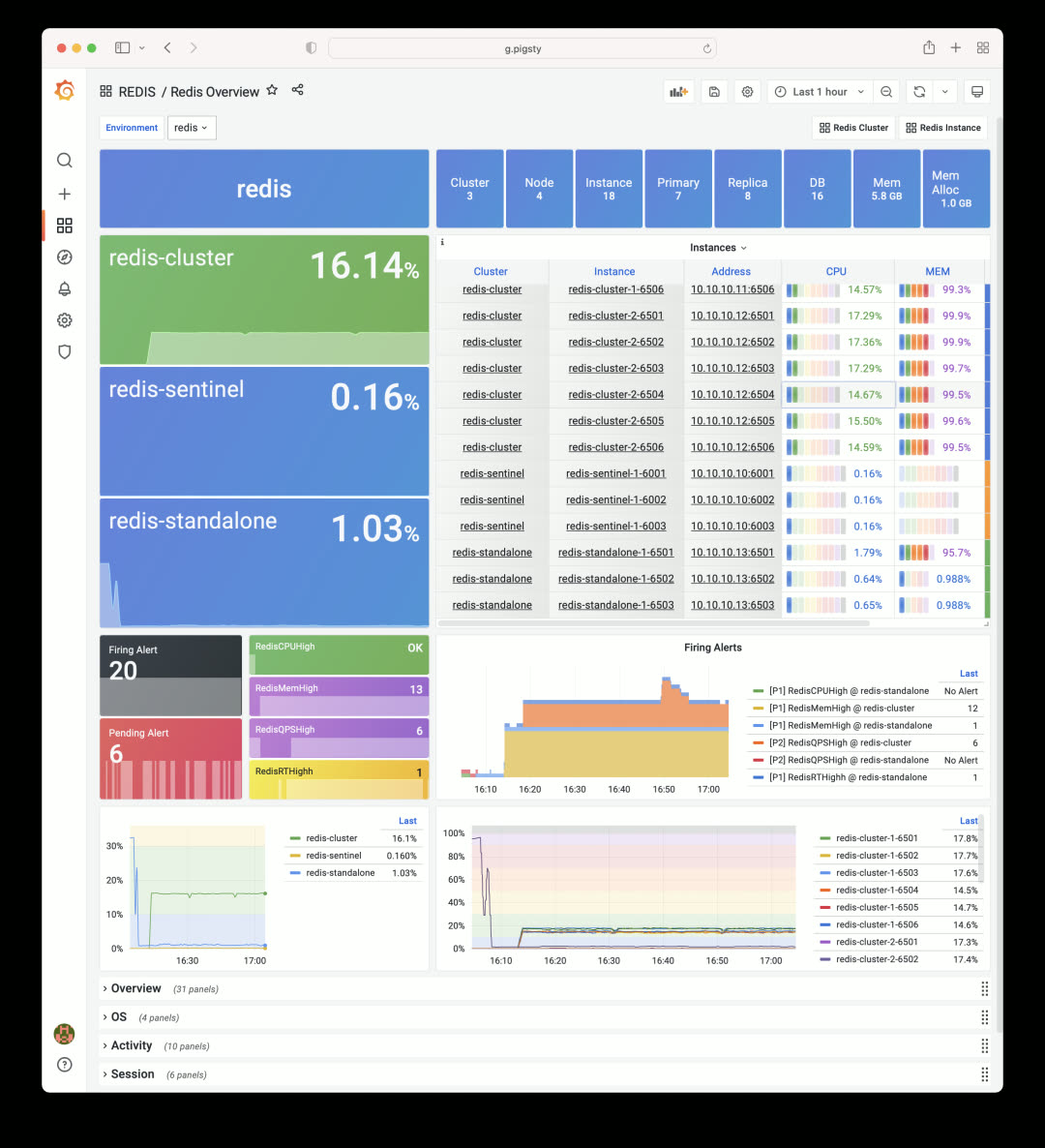
The Redis Overview dashboard shows three sample clusters, each demonstrating a different deployment mode.
Declarative Configuration
Defining a Redis cluster works the same way as PostgreSQL. After declaring your config, just run redis.yml -l <cluster> to create the cluster:
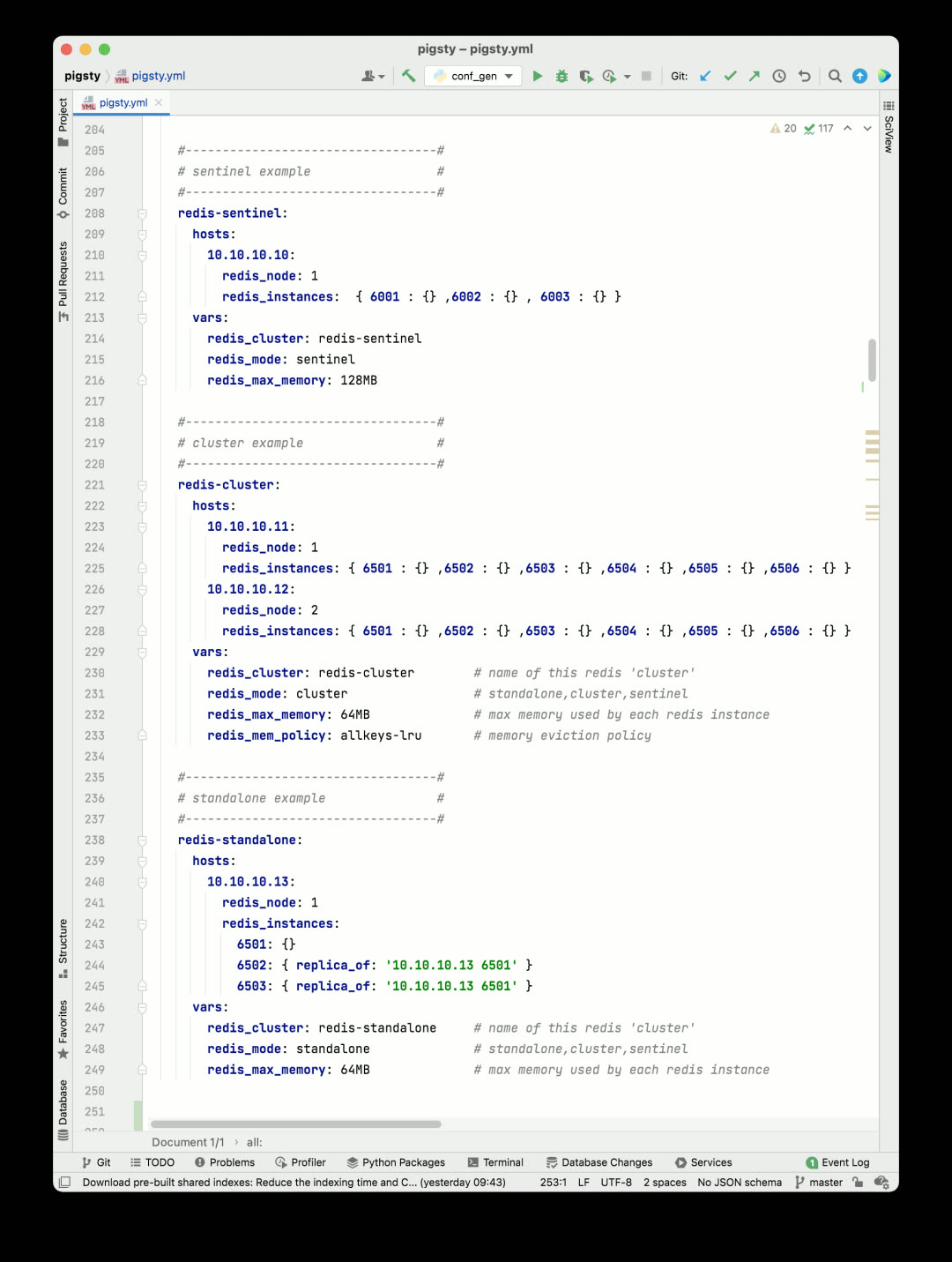
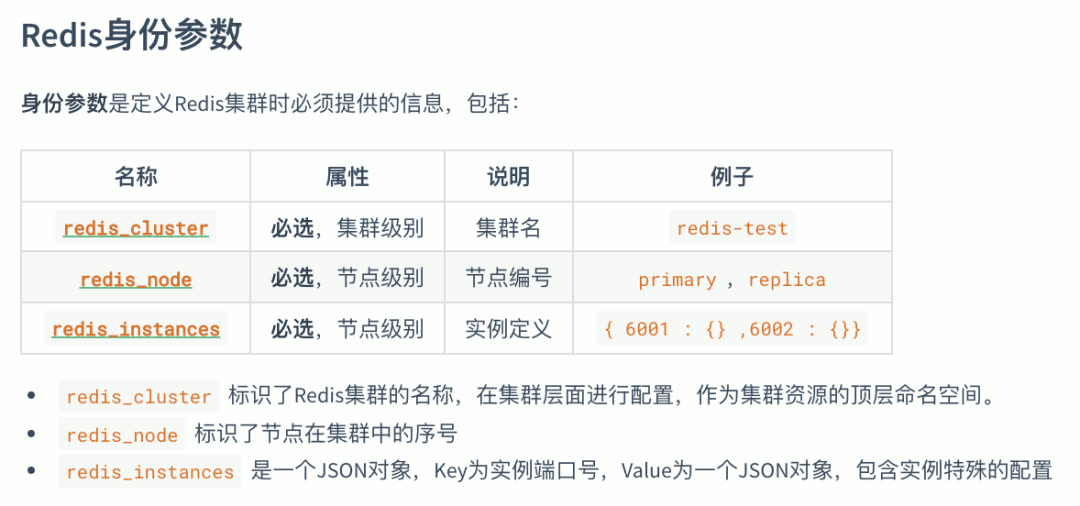
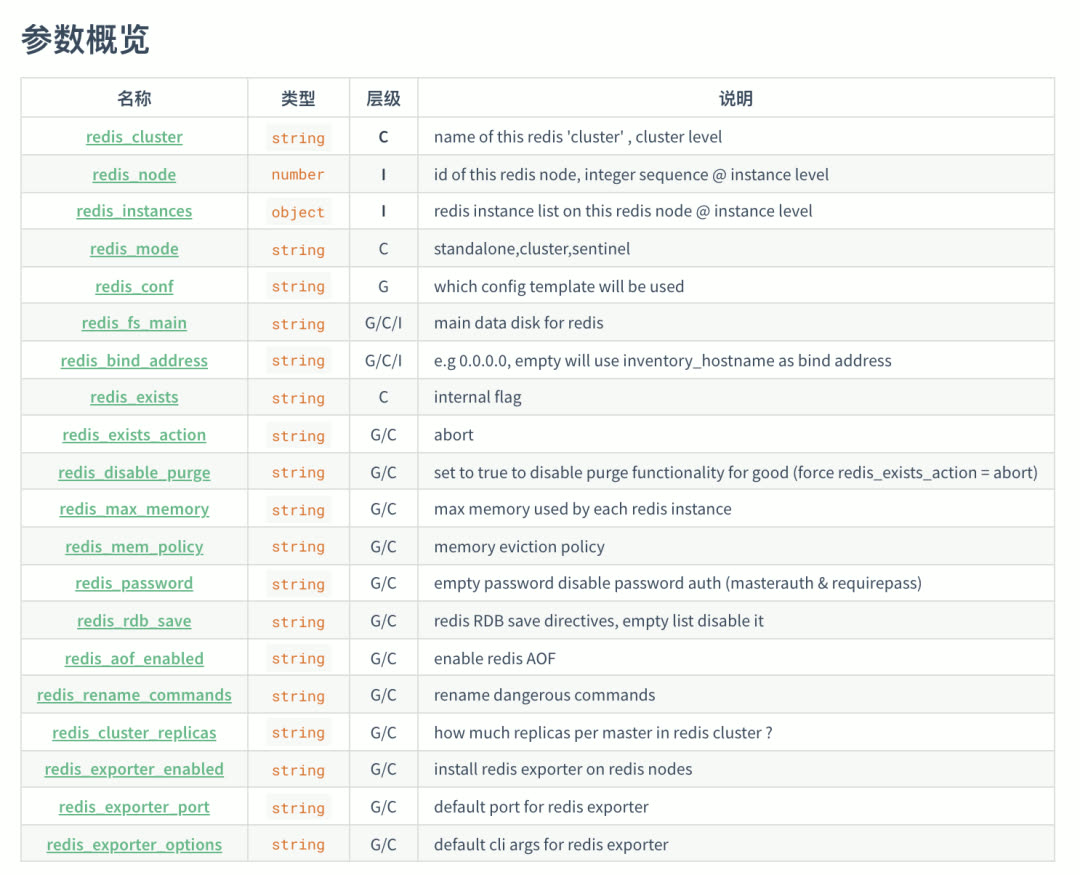
A Redis cluster only needs a few required identity parameters. Of course, you can use additional parameters for fine-grained configuration:
Auto-Monitoring
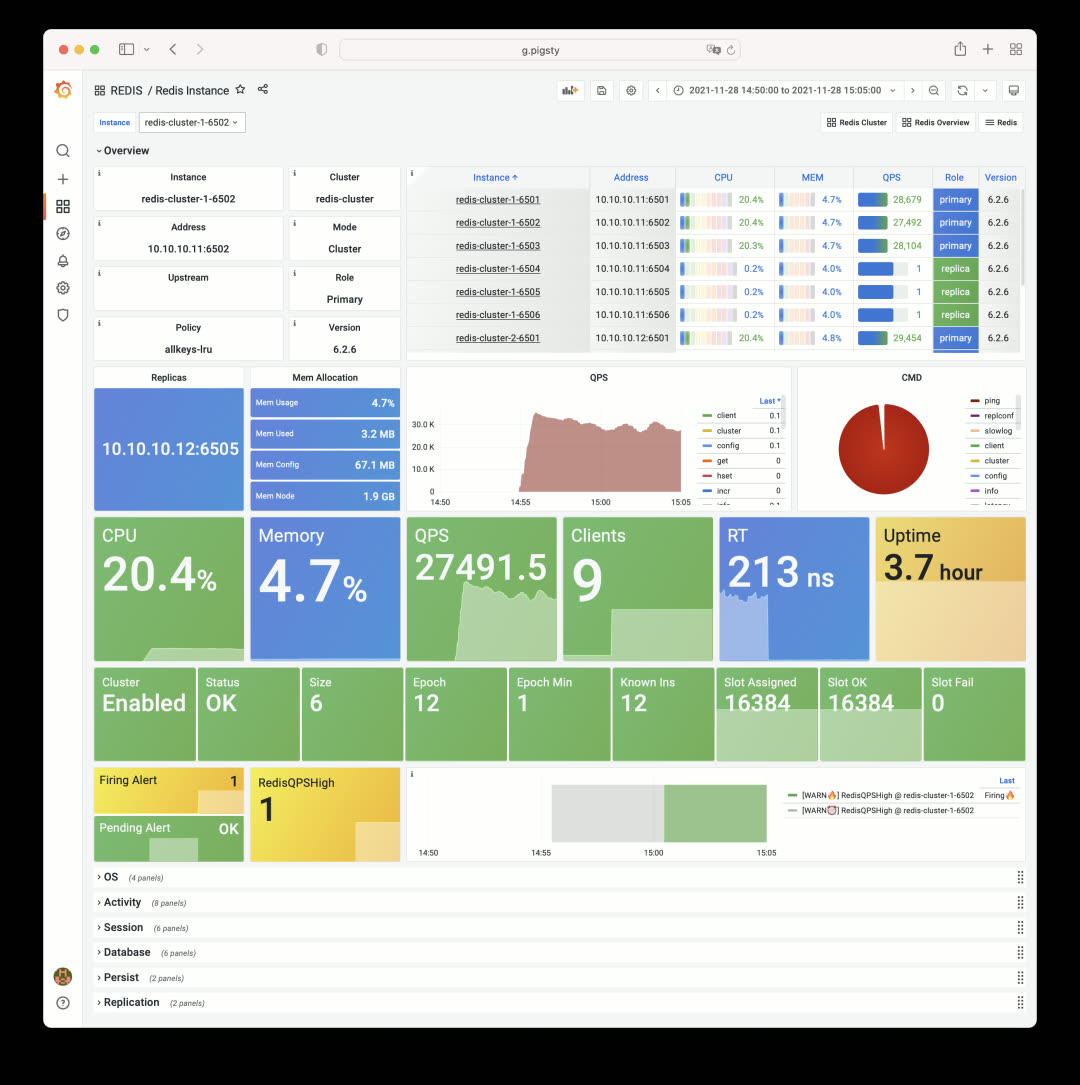
Redis clusters and instances created with Pigsty are automatically integrated into the monitoring system.
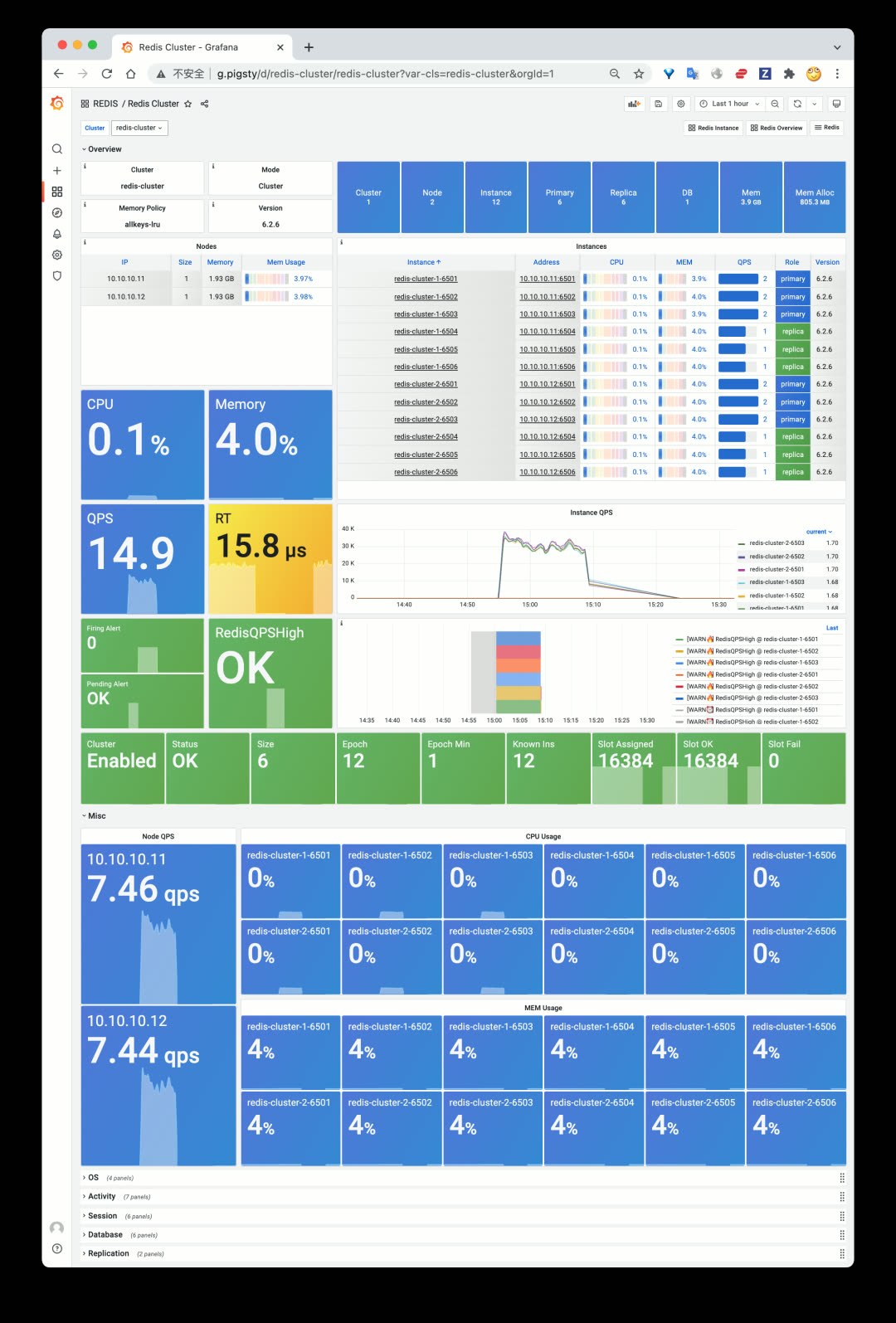
The Redis cluster dashboard homepage — click on a specific instance to jump to instance-level monitoring:
PGCAT Overhaul
v1.3 rebuilds the PGCAT application — a tool for browsing and visualizing PostgreSQL system catalogs directly from Grafana.
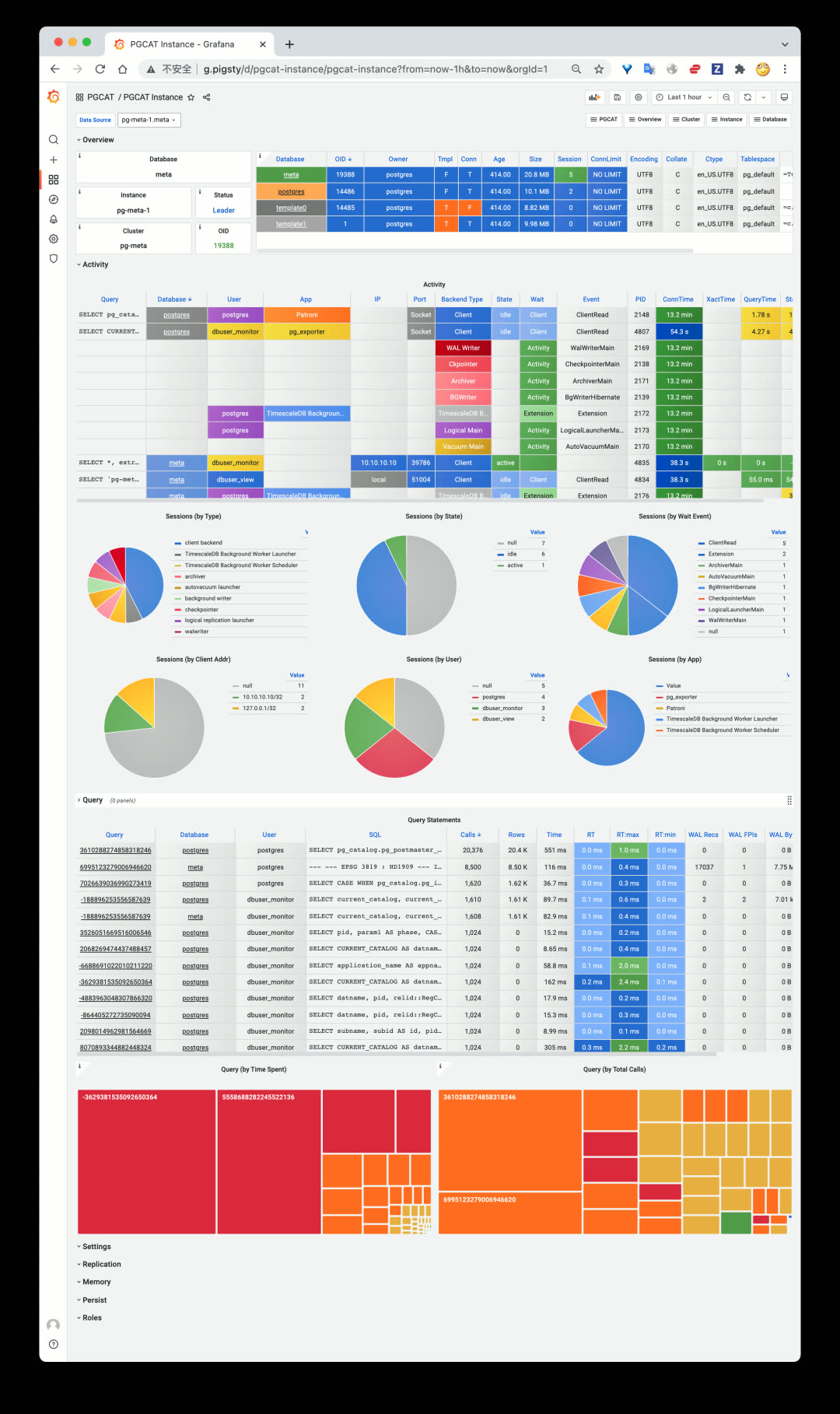
Single PostgreSQL instance catalog info: databases, active sessions, running queries.
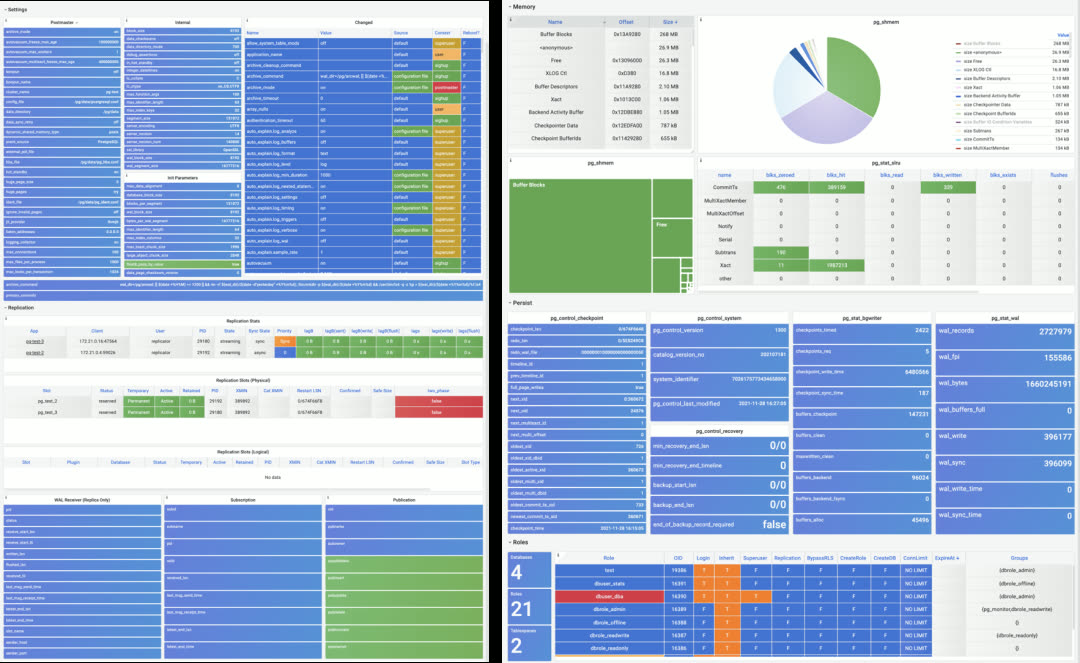
More instance-level catalog info: configuration, replication, memory usage, persistence, roles.
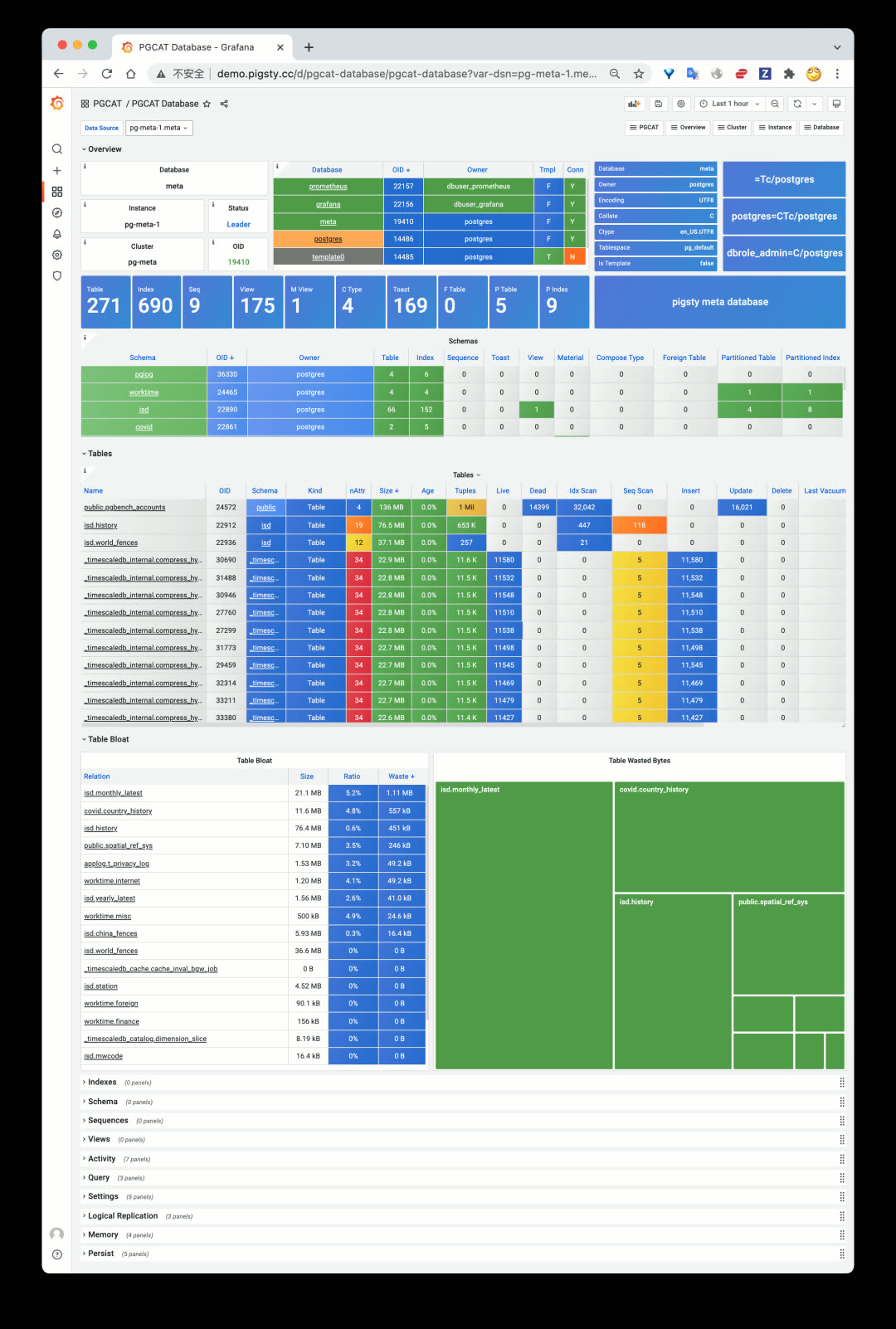
Single PostgreSQL database catalog info, including schemas, tables, indexes, sequences, and other objects.
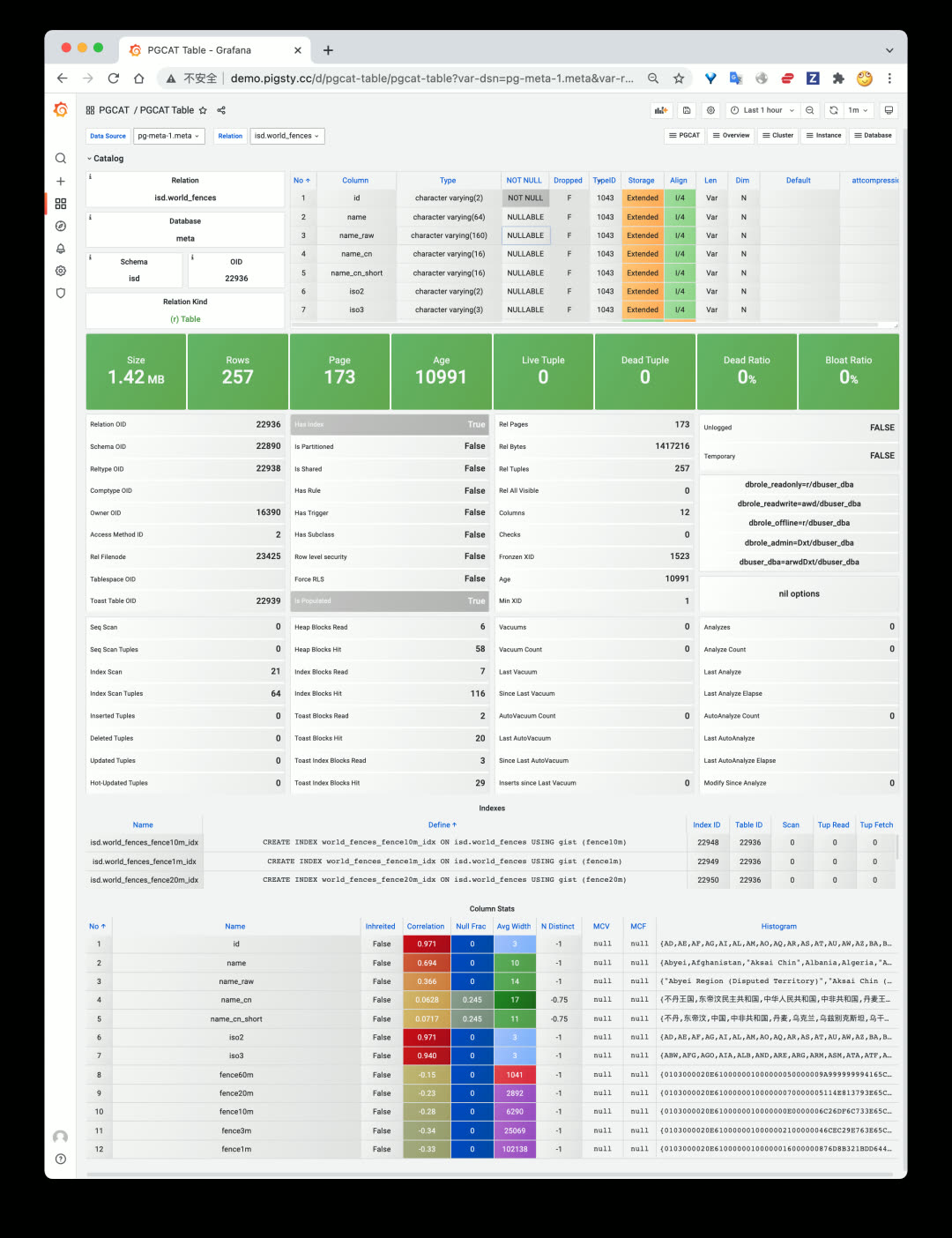
Redesigned PGCAT TABLE dashboard with detailed per-column statistics.
Agentless Design
PGCAT only needs a target database URL — no agent installation required. Even monitor-only deployments of existing instances get full PGCAT functionality.
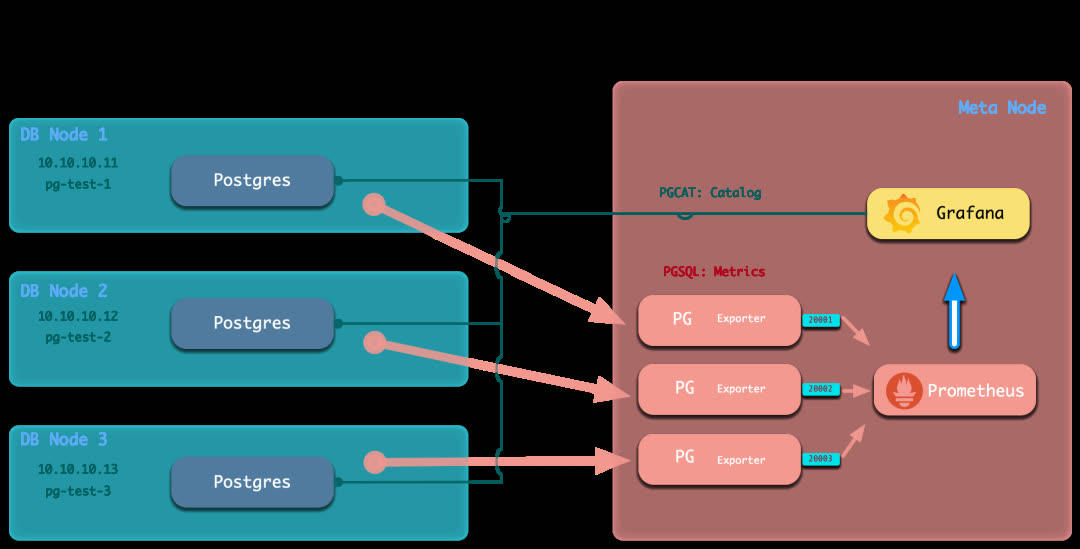
In Pigsty v1.3’s monitor-only deployment mode, external PostgreSQL instances are also registered in Grafana with PGCAT enabled by default.
PGSQL Enhancements
The core PGSQL monitoring application also received significant improvements.
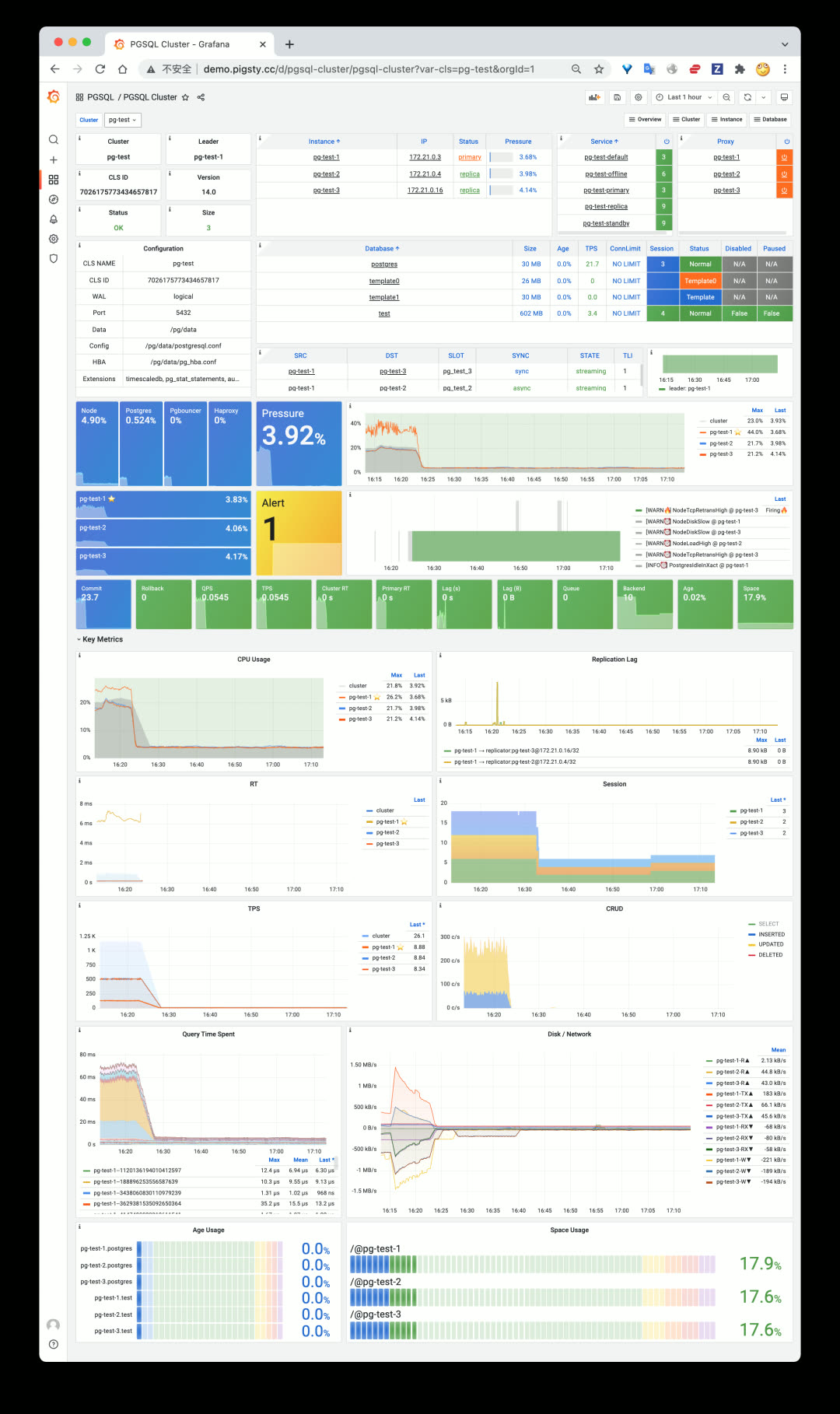
In Pigsty v1.3, the PGSQL Cluster dashboard adds quick-navigation panels for 10 key metrics.
Both PGSQL Instance and PGSQL Cluster now include quick-navigation panels for rapid problem identification. PGSQL Service was completely redesigned — simpler and more intuitive for quickly understanding cluster topology. Other dashboards also received optimizations and improvements.
Additionally, v1.3 includes improvements to the semi-automated database migration playbook and profiling tool support.
v1.3.0 Release Notes
Redis Support
| Feature | Description |
|---|---|
| Redis Deployment | Standalone, Sentinel, and Cluster modes |
| Redis Monitoring | Overview, Cluster, and Instance dashboards |
PGCAT Overhaul
| Dashboard | Description |
|---|---|
| PGCAT Instance | New instance-level catalog dashboard |
| PGCAT Database | New database-level catalog dashboard |
| PGCAT Table | Redesigned table-level dashboard |
PGSQL Enhancements
| Dashboard | Improvements |
|---|---|
| PGSQL Cluster | Added 10 key metric panels |
| PGSQL Instance | Added 10 key metric panels |
| PGSQL Service | Simplified and redesigned |
| Cross-references | Navigation links between PGCAT and PGSQL dashboards |
Monitor Deployment
- Grafana datasources auto-register during monitor-only deployment
Software Upgrades
- PostgreSQL 13 added to default package list
- PostgreSQL upgraded to 14.1 as default
- Added Greenplum RPM packages and dependencies
- Added Redis RPM and source packages
- Added
perfas default package
v1.3.1 Release Notes
Monitoring
- PGSQL & PGCAT dashboard improvements
- Optimized PGCAT Instance & PGCAT Database layout
- Added key metric panels to PGSQL Instance dashboard (consistent with PGSQL Cluster)
- Added table/index bloat panels to PGCAT Database, removed PGCAT Bloat dashboard
- Added index information to PGCAT Database dashboard
- Fixed broken panels in Grafana 8.3
- Added Redis index to Nginx homepage
Deployment
- New
infra-demo.ymlplaybook for one-click bootstrap - New
infra-jupyter.ymlplaybook for optional JupyterLab server - New
infra-pgweb.ymlplaybook for optional PGWeb server - Added
pgalias on meta node for starting PostgreSQL cluster from admin user - Adjusted
max_locks_per_transactionsin all Patroni config templates pertimescaledb-tunerecommendations - Added
citus.node_conninfo: 'sslmode=prefer'to config templates for SSL-free Citus usage - Added all extensions (except pgrouting) from PGDG14 to package list
- Upgraded node_exporter to v1.3.1
- Added PostgREST v9.0.0 for generating REST APIs from PostgreSQL schemas
Bug Fixes
- Grafana security vulnerability fix (upgraded to v8.3.1, details)
- Fixed
pg_instance&pg_serviceissues inregisterrole when starting playbook mid-run - Fixed Nginx homepage rendering on hosts without
pg_clustervariable - Fixed style issues when upgrading to Grafana 8.3.1